
The Mother Question

It was a day like any other. My young daughter, about six years old at the time, was hanging out with me while I made the bed in the master bedroom. I don’t recall the specific question she asked, but I remember my answer—an offhand remark rooted in my identity: “Because I’m your mother.”
Olivia’s head tilted, “You are?”
She wasn’t being defiant. Her words sounded curious. My heart did a slow, heavy sink into my stomach. For a few seconds I wondered if she was toying with me but her dark eyes remained wide and earnest.
“Of course I am,” I answered, my voice sounding thinner than I liked.
“You are my mother?” she repeated.
In the world of transracial adoption, there’s little doubt by the tender age of three or four years old that you don’t resemble your parents. My husband and I addressed the question, “Where do I come from?” before our adopted children could even talk. But there were times like these when we were caught off guard by something they asked or said. Frankly, in that moment, I felt a jab of inadequacy. I was the woman who held her through night terrors, the woman who knew exactly how she liked her toast, yet it seemed like I was being called out as a substitute by a small, gentle judge.
My mind raced back to two previous incidents. Over the summer I invited a friend and her daughter of Olivia’s age to swim in our pool. While the four of us perched on the coping surrounding the water, the little girl asked, “Are you Olivia’s real mother?” After an initial sting I felt for my daughter, my mind searched for an age-appropriate but truthful response. But before I could speak up, the mother scolded her daughter with, “We don’t ask about things like that.” But I wanted to talk about it. I felt both children deserved an honest answer, instead of one being chastised, and the other ignored. But the mom was insistent to silence any conversation, as though her daughter had broken some cardinal rule of adoption-speak.
It was a missed opportunity to bring that five-year old’s question into the light and explain how God sometimes forms families.
Then there was the breakfast breakdown. While preparing school lunches one morning, I heard Olivia’s characteristic low whine when she cries. When I whirled around to see what was wrong, there she sat at the table, her face practically in her cereal bowl. She cried out in tears, “My own mother didn’t even want me!”
I swooped in then, frantic for a rescue mission of words while my identity as her mother took a hit. I tried to reassure her that her biological mother did in fact want her, loved her and must have gone through terrible pain to have to give her up. Did it help? I’m not sure. Olivia is reserved, a quiet well of emotion difficult to draw from. She’s always been different from our son, who claimed his place in our family with a boisterous, unquestioning confidence.
Back in the bedroom, the silence was stretching too long. I decided to pivot. I couldn’t bridge the biological gap in a single conversation, but I could try and make light of the situation.
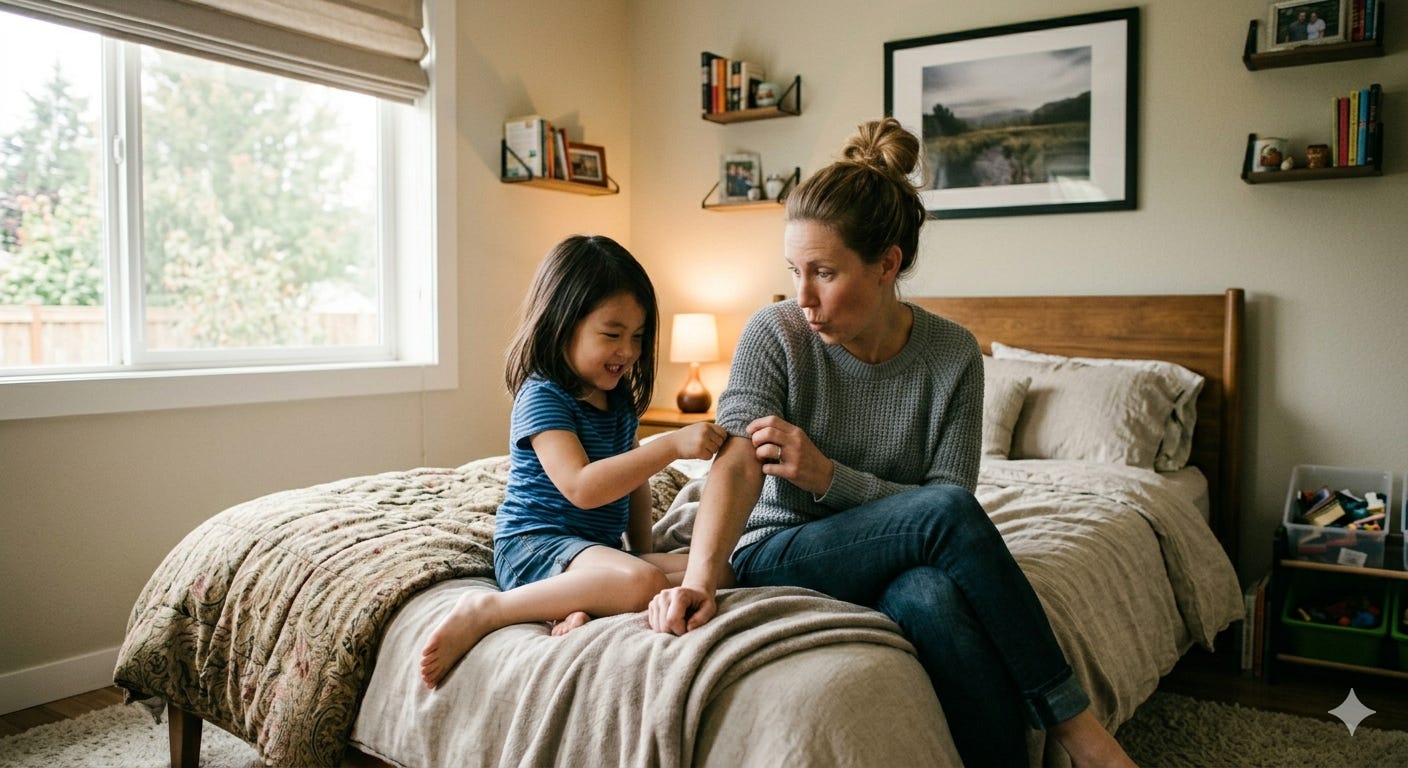
“Well,” I said, putting down the pillow, “I changed your diapers. I made your bottles. I rocked you to sleep. I love you to the moon and back. Yes, I’m your mother.” I leaned in close to her, a mischievous tone to my voice, “In fact, I’m so real, you should pinch me to make sure.”
She hesitated, then reached out and gave my arm a quick, sharp pinch.
“Ouch!” I yelped, hamming it up. “See? I’m real, I’m here, and I’m yours.”
Olivia let out a bright, sparkling laugh, and the tension evaporated. The topic was dismissed, replaced by a request for a snack, but the echo of longing and belonging remained in the room.
I’ve come to realize that as an adoptive parent, my feelings have to take a backseat to her reality. She carries a primal wound—a sense of abandonment by the woman who gave her life—and that sometimes translates into a skepticism of the woman who is raising her. It is not a rejection of me; she’s negotiating with her own history.
There are steps we adoptive parents can take are to ensure our children see themselves reflected in the world. We can participate in adoption support groups, culture camps, celebrations of our children’s ethnicities and make friends with other families who have interracially adopted. We can make sure our kids have someone with whom they feel safe discussing issues surrounding their abandonment and adoption.
As to what the future holds for Olivia in terms of her feelings and issues surrounding her adoption, I cannot know. But I do know that every time she pinches me to see if I’m real, I’ll be there to tell her that I am. I’ll keep showing up, holding the space for the mother she lost and the mother she has, until she finally feels she doesn’t have to ask anymore.
Beautiful
Great post, Christine! God has blessed you with His wisdom.